
Identity-Based Hate & Violence Training Series & Resources Now Available: Building Safer Communities Through Prevention
Identity-Based Hate & Violence (IBHV) Training Series and Resources are now publicly available, giving County departments, community organizations, educators, service providers, and residents free access to research-informed strategies for understanding, preventing, and responding to identity-based hate and violence.
Identity-based hate and violence refers to harmful behaviors that target individuals or groups because of characteristics central to their identity, such as race, ethnicity, religion, national origin, disability, sexual orientation, or gender identity. These behaviors can range from harassment and intimidation to discrimination, vandalism, online abuse, and acts of violence.
In partnership with the University of California – Los Angeles (UCLA), Bedari Kindness Institute, Los Angeles County Anti-Racism, Diversity, and Inclusion (ARDI) Initiative developed a four-part series to bring leading researchers, County practitioners, and community leaders together and explore how identity-based hate develops, the ways it affects communities, and practical approaches that support prevention.

ARDI Executive Director, D’Artagnan Scorza, Ph.D., opening up the Identity-Based Hate & Violence Training Symposium at UCLA.
The series concluded with an Identity-Based Hate & Violence Training Symposium, where over 100 participants reflected on key learning themes and discussed how research can strengthen public service, community partnerships, and prevention efforts across Los Angeles County.
With the availability of the training series and resources, anyone can access these conversations online and explore the same evidence-informed tools shared throughout the series.
Understanding the Challenges of Identity-based Hate and Violence in Los Angeles County
Identity-based hate and violence continue to affect communities throughout Los Angeles County, highlighting the importance of coordinated prevention efforts that extend beyond responding after harm occurs.
According to the latest edition of the Los Angeles County
Human Relations Commission’s Hate Crime Report, reported hate crimes in the region reached their second-highest level since the County began compiling these statistics in 1980. Approximately two-thirds of reported hate crimes were violent, and Black residents, who comprise approximately 9% of the County’s population, represented 51% of racial hate crime victims. The report also documented increases in hate incidents affecting several communities across Los Angeles County.

Panel discussion during focused on online hate and social media at the Identity-Based Hate & Violence Training Symposium.
This data underscores the need for practical, evidence-informed resources that help County departments, service providers, educators, and community organizations better understand identity-based hate and violence and strengthen their ability to support the communities they serve.
Building on earlier County efforts to address rising anti-Asian hate through the Los Angeles County Initiative on Anti-Racism, Diversity, and Inclusion for Asian Americans, Native Hawaiians, and Pacific Islanders (AANHPI), the Los Angeles County Board of Supervisors adopted the motion, Combatting Identity-Based Hate in Los Angeles County through a Comprehensive, Proactive, and Equitable Strategy. The motion recognized that preventing identity-based hate and violence requires a coordinated, countywide approach grounded in prevention, education, research, cross-sector collaboration, and community engagement.
This training series is one outcome of the Board’s direction and the County’s continued commitment to combatting identity-based hate & violence. Developed by ARDI in partnership with UCLA’s Bedari Kindness Institute, the series translates current research into practical strategies that help County employees, service providers, educators, and community partners recognize identity-based hate and violence, strengthen protective factors, and apply prevention-focused approaches within their own organizations and communities.
Focusing on Prevention and Spreading Promotion
Throughout the symposium, speakers emphasized that preventing identity-based hate and violence begins long before an incident occurs.
Opening the symposium, Dr. D’Artagnan Scorza, then Executive Director of ARDI, encouraged participants to think about prevention not only as stopping harm, but also as creating the conditions that help communities thrive.
“We have to focus specifically on prevention and promotion. Prevention is stopping bad things from happening, and promotion is helping good things occur.”
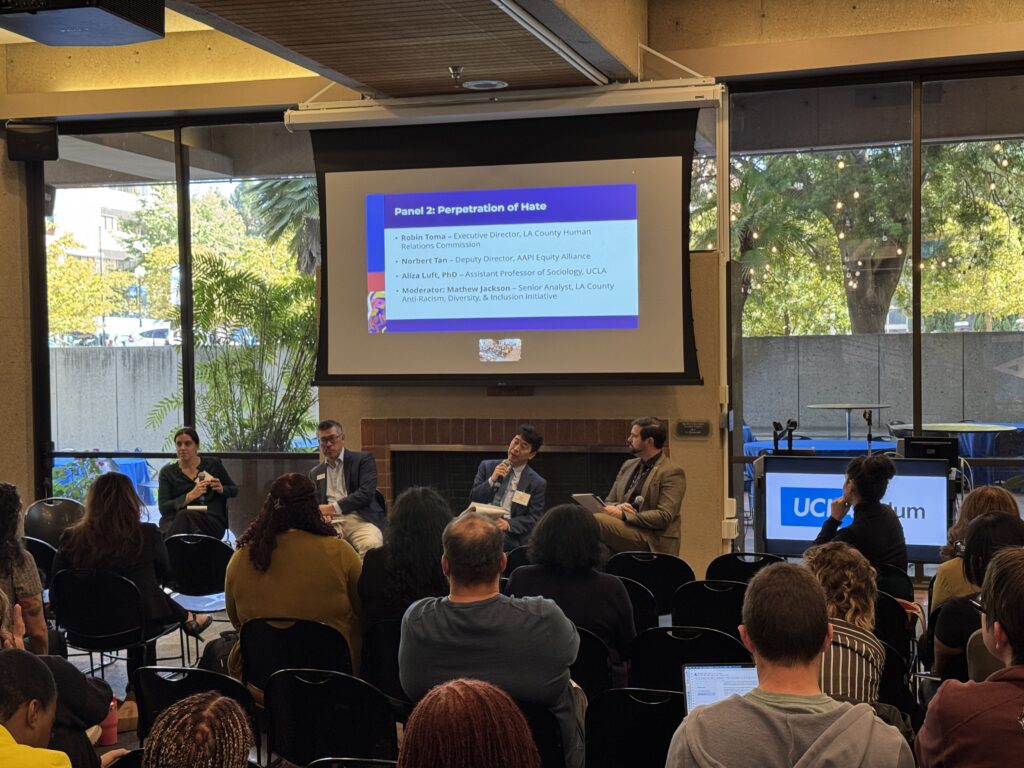
Panel discussion during focused on the perpetration of hate at the Identity-Based Hate & Violence Training Symposium.
Researchers from UCLA explored how online environments, artificial intelligence, and social media continue to shape the way identity-based hate spreads. They discussed how tech company algorithms can amplify harmful content, how online communities influence real-world behavior, and why emerging technologies require new approaches to prevention.
One of the symposium’s strongest themes centered on belonging.
Researchers explained that people often seek connection, validation, and community online. When those human needs are met in harmful spaces, identity-based hate can spread more easily. Consequently, prevention must not only focus on limiting harmful content, but also strengthening the protections around people – so individuals can develop healthy relationships, experience belonging, and engage positively with their communities.
Putting Academic Research into Real-World Practice
Throughout the symposium, presenters explored how research can inform the day-to-day work of County departments, service providers, and community organizations. In addition to introducing research findings, the training series challenged participants to think differently about how identity-based hate and violence can affect the people they serve and how evidence-informed approaches can strengthen prevention efforts across Los Angeles County.
Chief Diversity, Equity, and Inclusion Officer at the Los Angeles County Department of Children and Family Services (DCFS), Arena Turner, participated in the training series to deepen her understanding of identity-based hate and violence and explore how those insights could support DCFS’s ongoing equity work.
“I wanted to learn a little bit more about what identity-based hate means and how important it is to align the work that we’re currently doing to make sure that I bring more awareness to our department and for our communities.”
Turner said the symposium reinforced the importance of building awareness across the department as a foundation for prevention. Since completing the training series, she has shared resources and key learnings with colleagues and identified opportunities to incorporate insights from the trainings into DCFS’s ongoing work.
“Awareness is the first and critical step.”
With Turner reflecting on how the trainings and resources are strengthening organizational awareness, her colleague Jessica Brown, Office of Equity Program Support Manager at DCFS and a symposium panelist, elaborated how the research connects directly to the experiences of the children, youth, and families she supports through the work of her and her team.
During the symposium, Brown discussed how online hate can continue affecting young people long after they leave digital spaces.
“The online hate, they’re [children and youth] experiencing it not only when they’re online. When they turn that computer off, those messages don’t disappear.”
Brown explained that experiences like these are reflected in the research presented throughout the symposium. While the data help identify broader trends, she believes they also point to real people, families, and communities navigating those experiences every day.
Following the symposium, Brown reflected on how the training challenged participants to look beyond data and statistics to better understand how identity-based hate affects the people and their stories behind the numbers.
“We can have an academic discourse about what identity-based hate is or rates of cyberbullying, but are we talking about what that looks like in an individual or a family…”
The research informs the framework for understanding how identity-based hate can influence the daily experiences of children, youth, and families, reinforcing the importance of responding with empathy, curiosity, and a deeper understanding of the communities County employees serve.
Together, Turner’s and Brown’s experiences at DCFS illustrate how the Identity-Based Hate & Violence Training Series translates research into practice. By connecting academic research with lived experience and practical application, the series equips County employees and community partners with evidence-informed approaches they can incorporate into leadership, program development, and direct service, strengthening prevention efforts across Los Angeles County.
Continuing the Conversation
The Identity-Based Hate & Violence Training Series brings together academic researchers, County leaders, service providers and practitioners, and community leaders to explore various topics under identity-based hate and violence, including:
Whether someone is looking to deepen their understanding of identity-based hate and violence or identify new approaches within their own organization, the series offers practical, research-informed guidance that can be applied across a variety of settings.
Explore the Training Series and its Resources
Combatting Identity-Based Hate and Violence in Los Angeles County is an ongoing ARDI-led, Countywide effort to strengthen collaboration, continued learning, and shared commitment across sectors and communities.
The complete Identity-Based Hate & Violence Training Series is now available below.
Explore the training recordings and resources to learn how research, partnership, and prevention can help strengthen safer, more inclusive communities throughout Los Angeles County.
ARDI/UCLA Training Series Recordings
Session 3
presented by Daniel Fessler, Aaron Panofsky, Aliza Luft, and Howard Padwa